Soda ash dense supplier in Delhi: sodium carbonate, Na2CO3
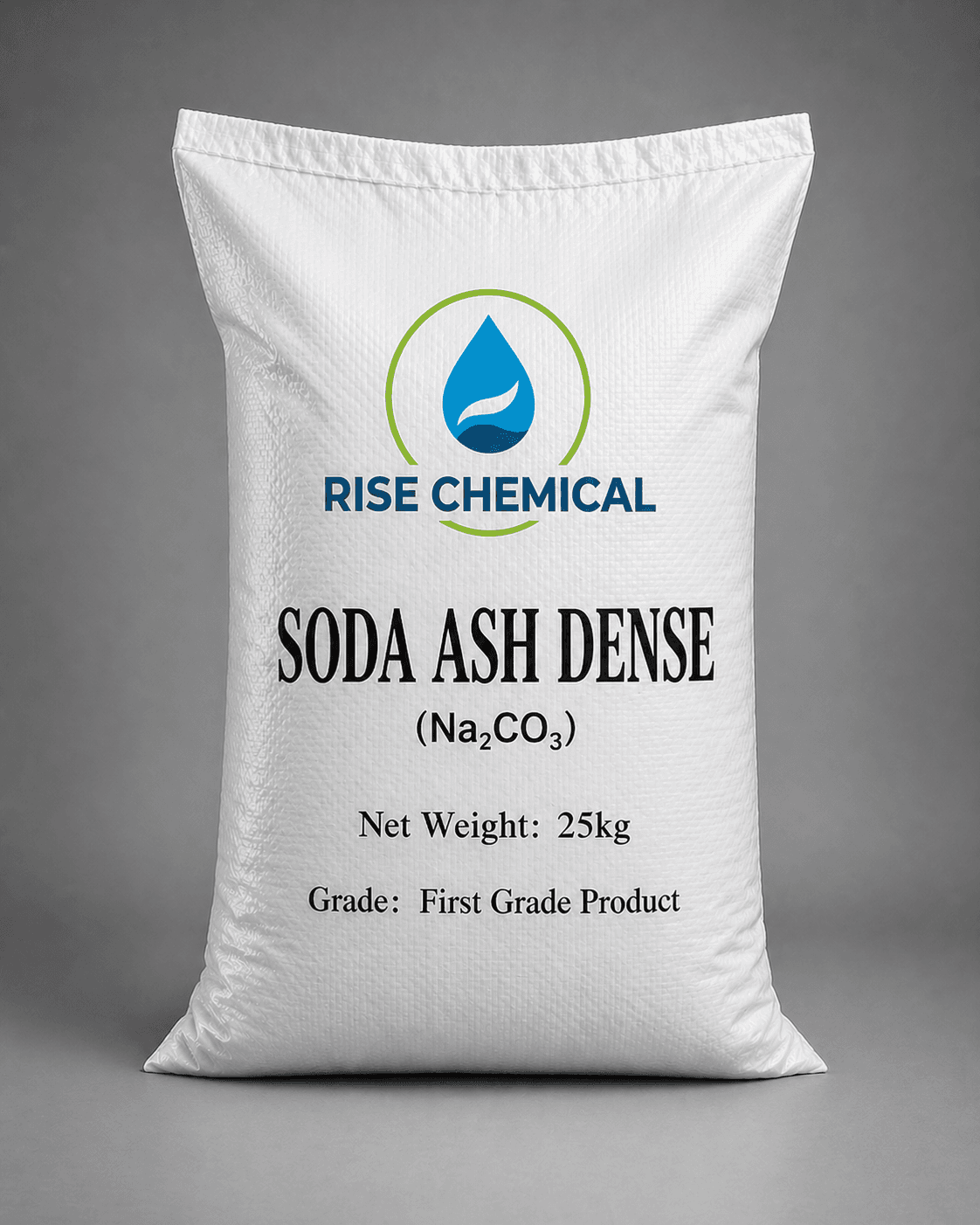
Rise Chemical India supplies soda ash dense, the granular grade of anhydrous sodium carbonate (Na2CO3), in 25 kg and 50 kg bags. The minimum order is 250 kg. Water plants dose it to raise pH and remove non-carbonate hardness, and glass and detergent makers use it as a raw material.
What is soda ash dense?
Soda ash is sodium carbonate, Na2CO3, a mild alkali. It raises pH more gently than caustic soda and adds carbonate alkalinity, which buffers water against pH swings. In softening, the carbonate reacts with calcium to form calcium carbonate, which settles out. The dense grade has a higher bulk density than light soda ash, so each bag holds more product and it raises less dust when tipped into a dissolving tank; light soda ash dissolves faster because its particles are finer.
Why Choose Rise Chemical India?
We sell soda ash dense from 250 kg, packed in 25 kg and 50 kg bags, and quote bulk quantities on request. Rise Chemical India is ISO 9001:2015 certified. Our own factory makes ferric alum and anionic polyelectrolyte, so a water plant can order its coagulant and flocculant with the soda ash on one purchase order. We export soda ash too; send your destination port and quantity for a quote.
Chemical & Technical Specifications
- Chemical Formula
- Na2CO3
- Appearance
- White Powder / Granular
- Grade
- Industrial Grade
- Solubility
- Highly Soluble in Water
- Packaging
- 25kg / 50kg Bags & Bulk Supply
Trade names and codes
- Also known as
- Sodium carbonate, Soda ash dense, Dense soda ash, Sodium carbonate anhydrous, Na2CO3
- CAS No.
- 497-19-8
- HS code
- 2836.20
- Minimum order in India
- 250 kg
- Supply
- India and export
Last updated:
Where soda ash dense is used
Frequently Asked Questions
Soda ash raises the pH and alkalinity of water and removes non-carbonate hardness. Its carbonate reacts with calcium to form calcium carbonate, which settles out; lime handles carbonate hardness, so softening plants often dose both. Because it adds alkalinity as well as pH, it helps coagulants such as PAC and alum work in soft, low-alkalinity water.
Both grades work, because both are the same sodium carbonate once dissolved; the difference is in handling. Light soda ash is a fine powder that dissolves faster. Dense soda ash, the grade we supply, is granular, flows freely, raises less dust and packs more product per bag, but needs longer mixing in the solution tank.
No: soda ash is anhydrous sodium carbonate, while washing soda is the hydrated crystal, Na2CO3·10H2O, which is mostly water by weight. For plant dosing, soda ash gives far more sodium carbonate per kg bought.
Soda ash (Na2CO3) is a mild alkali, and caustic soda (NaOH) is a strong one. Caustic soda moves pH faster and further, but it is corrosive and ships as Class 8 dangerous goods; soda ash is easier to handle and is not dangerous goods. Soda ash also adds carbonate alkalinity, which buffers pH, whereas caustic soda adds hydroxide.
The minimum order is 250 kg, which is five 50 kg bags or ten 25 kg bags. Larger quantities are quoted as bulk supply.
Soda ash keeps for 12 months in sealed bags stored in a dry place. It absorbs moisture from the air and cakes into lumps if bags are left open or kept on a damp floor.
Soda ash dense falls under HS 2836.20, its CAS number is 497-19-8, and it is not classed as dangerous goods for sea freight. Yes, we export it: send the destination port and quantity through the enquiry form or on WhatsApp at +91 95829 99838, and we will quote. The price depends on the quantity and the destination.